
Most people shopping for home internet don’t really know what they’re buying when it comes to speed. The internet provider offers a high-tier plan—like “Gigabit”—and leaves you wondering: Do I need this for working from home? For streaming? For keeping everyone connected at once?
The pitch is simple: upgrade to a faster speed for a better experience. But is that actually true?
As a former executive at one of the largest internet providers in America, I’ve seen how speed tiers work from the inside. Selling higher speeds is one of the primary ways internet companies increase revenue—and in most cases, faster speeds don’t actually improve your day-to-day experience. Even if you’re enjoying new competition in your area, you may still be paying for more speed than you need.
The tl;dr: You almost certainly don’t need a gigabit plan. A plan in the 200–300 Mbps range is the sweet spot for most households—fast enough for remote work, gaming, and streaming on multiple devices, at a fraction of the cost.
Are you shopping for home internet? Check out Wifi Shark to discover new providers and lower-priced plans in your area.
Lower speed tiers are much faster than advertised

Let’s take a look at how speed tiers are typically marketed across the industry. Many providers offer multiple speed tiers, but the way they describe those options can downplay how much you can actually do with lower speeds. Here’s the one thing you should know before we go any further:
A single Netflix HD stream only needs 5 Mbps.
And it’s a perfect benchmark for measuring internet speed. Gaming and videoconferencing require a similar amount of bandwidth, so using “Netflix streams” gives us an idea of how much activity each plan can support.
| Speed (Mbps) | Price | How It’s Typically Advertised | The Reality |
|---|---|---|---|
| 150 Mbps | $ |
|
30 Netflix HD Streams |
| 400 Mbps | $$ |
|
80 Netflix HD Streams |
| 600 Mbps | $$$ |
|
120 Netflix HD Streams |
| 1,100 Mbps (1 Gig) | $$$$ |
|
220 Netflix HD Streams |
| 2,100 Mbps (2 Gig) | $$$$$ |
|
420 Netflix HD Streams |
If you were relying on typical speed tier advertising and wanted to make sure your Netflix worked consistently, I wouldn’t blame you for choosing a 1 Gig or 2 Gig plan. After all, who doesn’t want their internet to work with “extreme speed”?
The reality is different—even a 150 Mbps plan can support dozens of high-quality, lag-free HD streams simultaneously.
Some common ways speed tier marketing can be misleading across the industry:
- Implying you need 400+ Mbps for HD quality
- Suggesting 600+ Mbps is necessary to stream on multiple devices
- Underrepresenting the number of devices that lower speed tiers can actually support
To be fair, faster speed does make a difference for one thing: downloading or uploading big files from the internet. If you’re someone who regularly moves large files (usually for a professional reason), a faster plan can save you time. A 30-minute HD video file takes 2 minutes to download over 100 Mbps, but only 12 seconds over 1 Gig. But this isn’t a good reason for most people to upgrade their internet speed.
Americans are buying more speed than they need
Speed tier marketing is driving millions of Americans to pay for internet speeds they don’t need. Gigabit plans can cost an extra $50 or more than lower-speed options. One regional fiber provider, Ziply, demonstrates this pricing gap clearly.
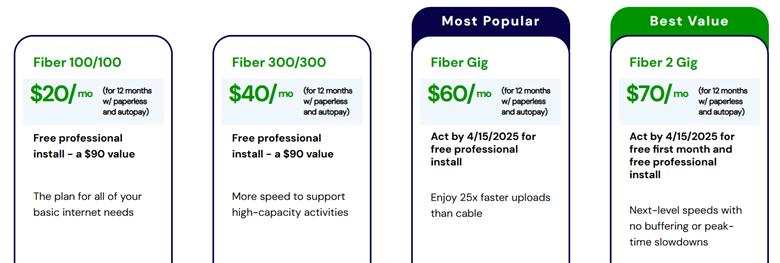
The push toward premium speed tiers has proven extremely lucrative for providers. Frontier, another regional fiber provider, has been so successful that it now drives over 60% of its customers to gig-speed plans, the highest of which (7 gigabit) starts at $110/month.
Why is this happening?
To understand why ISPs sell Americans multiple speed plans, we need to take a step back to the beginning of the home internet industry. As you’ll see, there was initially a practical reason for introducing speed tiers—but over the last 15 years, the rationale has shifted largely to marketing.
1990s: 56K and the dawn of home internet
Remember when it would take forever for a simple image to load? ISPs in the 90s would advertise that you could “download pictures and information in minutes” (a big deal then), access chat rooms, and use instant messaging. Terms like “lightning fast” were used to distinguish 56K service from older technologies like 28.8K.
There were no speed tiers, only internet providers trying to deploy the latest technology—all of which were slow compared to today.
2000s: Speed tiers introduced for network management
Internet became a lot faster in the 2000s. Going from 56K to even 1 Mbps was transformative—activities that used to take over an hour, like downloading a 3-minute song, could be accomplished in under a minute. The internet could now handle simple video clips, and services like YouTube emerged, creating the foundation for the streaming platforms we use today.
The 2000s were also a time of real technological constraints for internet networks. ISPs introduced speed tiers to navigate these limitations. Tiered pricing helped ISPs segment heavy users and incentivize lighter users to choose lower-speed plans, minimizing congestion and managing traffic efficiently.
2010-today: Speed tiers become a marketing tool
By the 2010s, many of the technical limitations that once justified speed tiers had largely been resolved. Internet speeds surged to 100 Mbps or more, and eventually gigabit plans (1,000 Mbps) became widely available. Any of these speeds could deliver the music, video, and gaming applications we enjoy today.
In line with Americans’ internet usage, the FCC started defining broadband internet as 25 Mbps—a speed which could “enable users to originate and receive high-quality voice, data, graphics, and video telecommunications.” This definition was only updated to 100 Mbps in 2024.
However, instead of scaling back the tier system, many providers shifted its purpose.
With modern internet infrastructure now capable of delivering high speeds to every connected home, speed tiers became more of a pricing and marketing strategy. Faster plans were positioned as essential for a “smart home” or a “fully connected family,” while lower-speed plans were labeled as “basic” or “limited”—even though those plans are more than sufficient for most households.
I’m not the only expert saying this
Some of the most experienced voices in the telecom industry have raised questions about the marketing hype around faster speeds.
Take Scott Imhoff, SVP of Product Management at Cambium Networks, a major global manufacturer of wireless broadband infrastructure. With decades of experience deploying network solutions, Imhoff cautions against the push for faster speeds, arguing that as consumers get charged more, their actual usage may not increase despite having the capacity to do so. He believes the opportunities for the average consumer to fully take advantage of gigabit speeds are limited, and that many will end up dissatisfied with what they’re paying relative to what they actually use.
Liam Bal, CEO of international ISP Spintel, has echoed this view, noting that a typical household of one or two users would be well served by a 50 Mbps plan, and that better education on actual speed needs can help customers save money and feel more confident in their choices.
A study from The Wall Street Journal, conducted in collaboration with researchers at Princeton and the University of Chicago, backed up these claims with real data. The study tracked 53 households and found:
- Users utilized only a fraction of their available bandwidth, even with multiple HD streams running simultaneously.
- In one test, users running up to seven simultaneous streams averaged just 7.1 Mbps of actual usage.
- Paying for more than 100 Mbps delivered marginal benefits. Picture clarity didn’t improve significantly, nor did video start times.
- One participant on a 15 Mbps plan had no problem handling multiple streams.
Together, these insights paint a clear picture: what began as a technical necessity for tiered speed offerings has evolved into a marketing strategy. Research suggests that most households’ actual usage could be served by as little as 100 Mbps. We recommend plans in the 200–300 Mbps range as a practical starting point with plenty of headroom, and avoid overpaying for gigabit speeds you’ll never use.
Where do we go from here?
There’s one ISP doing things differently.
Sonic, a California-based internet provider, avoids selling customers different speeds. They offer one plan: 10 Gigabits for $49.99/month. There are no tiers—just one offer that provides the same maximum throughput to every user.
Practically speaking, users won’t notice any difference in streaming quality whether they’re on a 200 Mbps or 10 Gigabit connection. But for the internet industry, Sonic’s approach is refreshing—and it may point toward where the industry is headed as competition increases.
What began as a way to manage real bandwidth limitations has evolved into a marketing strategy. In the future, I’ll explore what’s being done to address this issue from a policy perspective. But for now, to answer the question “what internet speed do I need?”—I hope you have everything you need to make an informed decision.
Are you shopping for home internet? Check out Wifi Shark to discover new providers and lower-priced plans in your area. For more tips, check out our shopping guide to learn about other ways to save on your internet bill.